
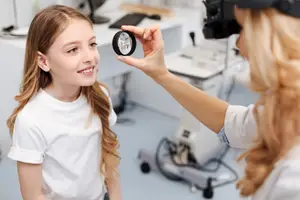
Children’s eyes change quickly. A stronger glasses prescription every year may feel common, though rapid progression deserves a closer look. McCormack Optometric Centre provides myopia management in Edmonton with long-term care plans designed around your child’s developing vision.
Parents often notice the small signs first. A child moves closer to the television. Books drift nearer to their face. Squinting becomes part of homework time. Then comes another prescription update, followed by another a year later.
For many families, this pattern feels routine. Yet myopia progression involves more than blurry distance vision. As the eye grows longer over time, the risk for future eye health concerns can also rise. That is why many families now seek myopia management for children instead of relying on stronger glasses alone.
At McCormack Optometric Centre, our optometrists take a careful, measured approach to pediatric eye care. We help parents understand how their child’s vision is changing and whether treatment options may help slow progression over time.
What Is Myopia?
Myopia, often called nearsightedness, affects how clearly a child sees objects at a distance. Children with myopia may read books comfortably up close but struggle to see classroom boards, road signs, or distant objects clearly.
Myopia develops when the eye grows too long from front to back. Light entering the eye focuses slightly in front of the retina instead of directly on it, which creates blurry distance vision.
For many children, myopia begins during elementary school years and continues progressing throughout adolescence.
Several factors may contribute to myopia progression, including:
-
Family history of nearsightedness
-
Increased screen use and near work
-
Limited outdoor activity
-
Early onset of myopia in childhood
Children today spend more time indoors and more time focusing on nearby screens than previous generations. Because of this, myopia rates continue to rise across Canada and around the world.
Why Myopia Progression Matters
Many parents assume stronger glasses simply come with growing up. In some cases, gradual changes are expected. Rapid progression, however, deserves closer monitoring.
Higher levels of myopia may increase the future risk of conditions such as:
-
Retinal detachment
-
Glaucoma
-
Cataracts
-
Myopic macular degeneration
This is where myopia management differs from standard prescription updates. Traditional glasses help children see clearly today. Myopia management examines how quickly the prescription changes and whether treatment may help slow that progression over time.
That long-term perspective matters, especially for younger children whose eyes still have years of development ahead.
Signs Your Child May Need Myopia Management
Children rarely realize their vision has changed because the change often happens gradually. Parents and teachers usually notice the clues first.
Your child may benefit from a myopia assessment if they:
-
Sit very close to screens
-
Hold books close to their face
-
Squint frequently
-
Struggle to see the classroom board
-
Complain of headaches or tired eyes
-
Need stronger prescriptions year after year
Even small prescription changes can reveal important patterns over time. A comprehensive eye exam allows your optometrist to track those changes carefully.
Myopia Control for Children in Edmonton
At McCormack Optometric Centre, myopia management starts with understanding the full picture of your child’s vision.
During the assessment, your optometrist reviews:
-
Current prescription strength
-
Previous prescription history
-
Eye health and development
-
Lifestyle and visual habits
-
Family history of myopia
From there, we explain whether your child’s prescription changes appear stable or progressive. Parents receive clear answers without pressure or confusing medical jargon.
Our clinic offers several myopia treatment options in Edmonton depending on your child’s needs.
Orthokeratology (Ortho-K)
Orthokeratology uses specially designed contact lenses worn overnight while sleeping. These lenses gently reshape the front surface of the eye so children can see clearly during the day without glasses or daytime contact lenses.
Many families appreciate the freedom Ortho-K provides for sports, outdoor activities, and school.
Low-Dose Atropine Therapy
Low-dose atropine eye drops may help slow myopia progression in some children. These drops are typically used as part of a broader management plan and monitored carefully through follow-up visits.
Myopia Control Glasses
Specialized lenses such as Stellest® and MyoCare are designed differently than traditional glasses. These lenses support clear vision while also helping manage how light focuses inside the eye.
For some children, myopia control glasses offer a comfortable and effective starting point for treatment.
Why Routine Eye Exams Matter
Myopia management works best as a long-term strategy rather than a single appointment. Children’s eyes continue changing as they grow, which means regular monitoring remains an important part of care.
Routine eye exams help your optometrist evaluate:
-
Whether progression has slowed
-
Whether treatment remains effective
-
If adjustments should be made
-
How your child’s eyes continue developing
At McCormack Optometric Centre, families receive continuity of care from a collaborative eye care team that has served West Edmonton since 1986. Our approach stays grounded in careful assessments, straightforward guidance, and long-term patient relationships.
Myopia Treatment in Edmonton for Growing Families
Parents often feel overwhelmed after hearing unfamiliar terms or researching online late at night. Our role is to simplify the process and guide families through each step with clarity.
We believe parents deserve honest answers about what is happening with their child’s vision and what options may help protect their long-term eye health.
If your child’s prescription keeps changing, a myopia assessment may provide the clarity you have been looking for.
McCormack Optometric Centre provides myopia management for children in Edmonton with personalized care plans, modern diagnostic technology, and a team-focused approach that has supported local families for generations.
Call our clinic or request an appointment today to learn more about myopia control for children.